

Integrated Circuits
Contents
ToggleIntegrated Circuits (ICs) are used to manufacture Digital Components. Integrated Circuits pack thousands to billions of transistors into tiny silicon chips revolutionizing electronics from room-sized computers to pocket smartphones. An IC is a tiny piece of silicon semiconductor, often called a chip, that contains electronic components arranged to perform digital logic operations. Inside the chip, multiple logic gates are connected together to create the required digital function. These chips miniaturize entire circuits, slashing size, cost, and power while boosting speed. Various gates are interconnected inside a chip to obtain the required circuit.
The chip is enclosed in a protective ceramic package, and very thin metal (usually gold) wires connect the internal circuitry to the external pins of the package. These pins allow the IC to be connected to other components on a circuit board. Depending on the complexity of the IC, the number of pins can vary from about 14 pins in simple chips to 100 or more pins in advanced packages. Each IC carries a unique identification number printed on its surface. Manufacturers provide detailed datasheets or catalogs that describe the pin configuration, internal structure, and operating characteristics of their ICs.
Advancements in semiconductor fabrication have significantly increased the number of logic gates that can be integrated onto a single chip. Based on the gate density, ICs are classified as Small-Scale Integration (SSI), Medium-Scale Integration (MSI), and Large-Scale Integration (LSI), with higher levels providing greater functionality within a compact form factor.
Characteristics & Key Features of ICs
Miniaturization: 100M transistors/mm² (vs discrete wiring spaghetti).
Reliability: No solder joints, vibration-proof.
Low Power: CMOS switches efficiently.
High Speed: Nanosecond gates, GHz clocks.
Cost Efficiency: Mass production drops $/function.
Scalability: From logic gates to billion-core GPUs.
Types of Integrated Circuits by Complexity (Scale of Integration)
Small Scale Integration (SSI)
10-100 gates or 100 transistors
1960s-1970s technology
- Examples:
7400 (4 NAND gates)
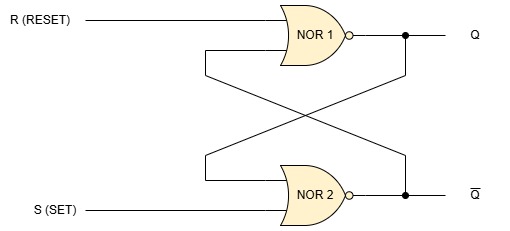
7474 (SR flip-flop)
7483 (4-bit full adder)
Use: Basic logic, breadboards, teaching kits
Medium Scale Integration (MSI)
100 -1000 gates or 1000 transistors
1970s technology
- Examples:
74138 (3-to-8 decoder)
74161 (4-bit counter)
74181 (4-bit ALU)
Use: Adders, multiplexers, registers
Large Scale Integration (LSI)
1,000-100,000 gates or ~100K transistors
Late 1970s
Examples:
Intel 4004 (2,300 transistors, first microprocessor)
8K RAM chips
UARTs, keyboard controllers
Very Large Scale Integration (VSLI)
100,000-1M+ gates or millions transistors
1980s-present
Examples:
Intel 8086 (29K transistors)
ARM Cortex-M (32-bit MCUs)
1MB DRAM chips
Ultra Large Scale Integration (ULSI)
Billions transistors
1990s-present
Examples:
Apple M1 (16B transistors)
NVIDIA RTX 4090 (76B)
Samsung 64Gb DRAM
The digital integrated circuits are also classified by their technology in which they belong.
Types of Integrated Circuits by Technology
TTL (Transistor-Transistor Logic)
- Pros: Fast (10ns), robust, 5V standard
- Cons: High power (10mW/gate), heat
- Series: 74 (std), 74LS (low power), 74S (Schottky-fast)
CMOS (Complementary Metal Oxide Semiconductor)
- Pros: Ultra-low power (nW standby), scalable, 1.8-5V
- Cons: Slower switching, ESD sensitive
- Series: 74HC (high speed), 74AC (advanced)
ECL (Emitter Coupled Logic)
- Pros: Ultra-fast (sub-ns), used in supercomputers
- Cons: High power, -5.2V, expensive